
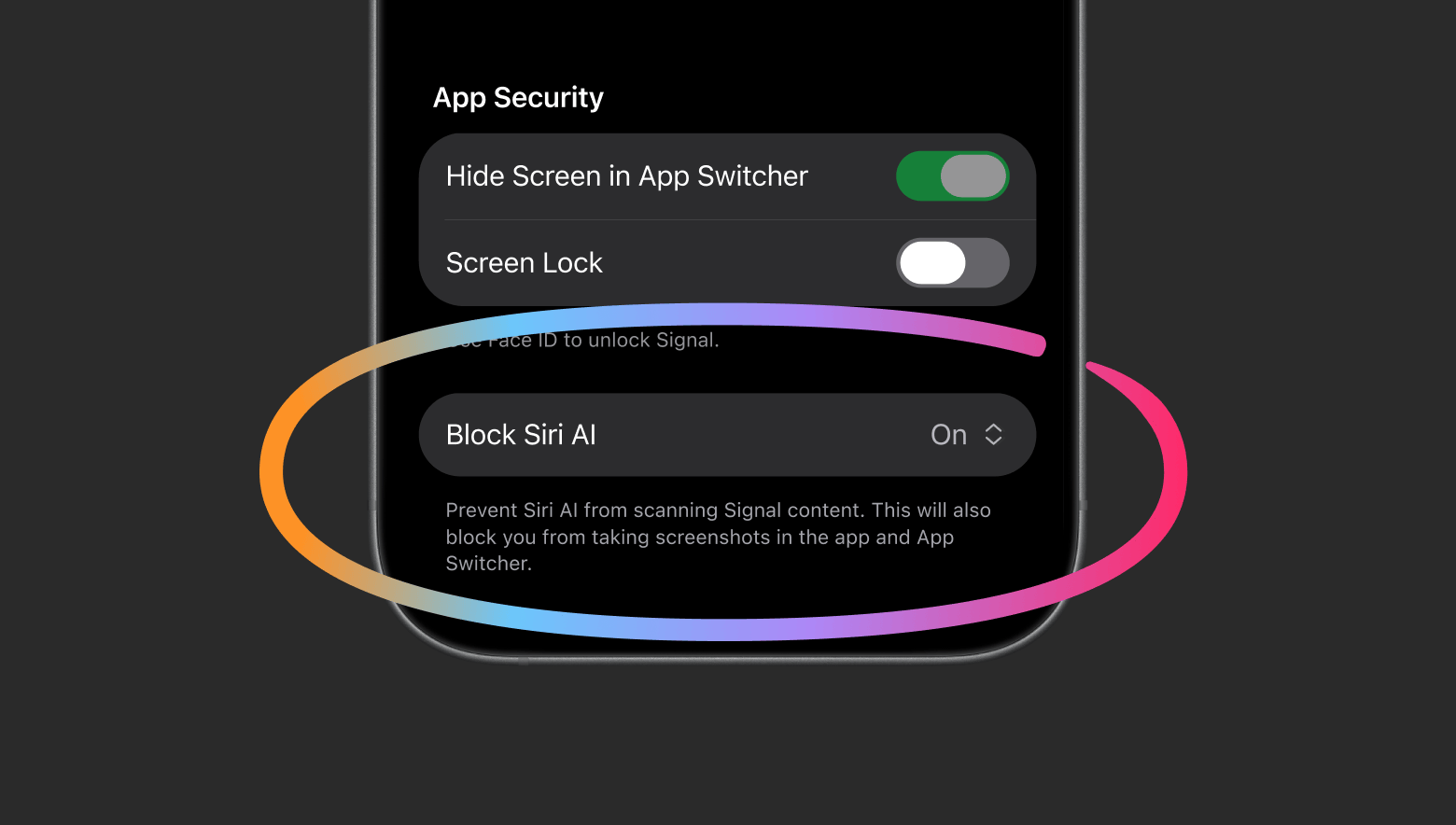
On November 20, 2026, Signal President Meredith Whittaker published "Signal is Serious About Protecting Your Privacy," drawing a hard boundary against operating system monopolies. Having previously rolled out default screenshot blocking on Windows 11 to neutralize Microsoft Recall, Signal has now brought the fight to mobile OS agents: iOS 27 ships with a default-on Block Siri AI toggle that disables in-app and App Switcher screenshots, while Signal on Android automatically triggers Screen security the moment it detects an AI assistant attempting to inspect the display. The announcement targets Apple's Onscreen Awareness (Siri AI) and Google's Gemini Intelligence head-on.
From an attack-surface and cost-arbitrage standpoint, the asymmetry is brutal. Breaking Signal's formally verified 256-bit Double Ratchet protocol over the wire demands 2²⁵⁶ operations—cryptographically infeasible at any compute budget. Reading the rendered compositor buffer or accessibility tree after decryption, however, exposes the exact same plaintext in 0 ms of cryptanalysis at near-zero marginal cost. This is hardly hypothetical: Reuters revelations the exact same week showed Meta's Muse AI agent scrambling user threads and exposing private cross-app data through over-privileged access, proving how accessibility frameworks meant for human users have become an OS-wide skeleton key for AI scrapers.
For over a decade, security engineers built unbreakable armored vaults to carry every letter safely across hostile networks, only to seat an always-on OS assistant directly above the desk photographing every line on the glass. The sharpest indictment sits buried in footnote 3 of Signal's macOS 27 disclosure: Apple deprecated general screenshot-blocking interfaces while preserving rock-solid screen-capture locks exclusively for streaming video and DRM-protected media. Movies stay locked; your private chats stay wide open.
The root architectural bottleneck is unforgiving: a user-space sandbox cannot enforce stronger isolation than the host OS governing its compositor, filesystem, notification bus, and accessibility API. Signal openly admits its mobile screenshot defense is incomplete. Blocking screenshots cannot stop OS agents from reading data already persisted to disk, cannot behave uniformly across fragmented Android OEM skins, and leaves macOS 27 users with only a manual workaround under System Settings > Siri > Excluded Apps. Nor does "confidential computing" marketing resolve the core flaw, because the OS vendor still retains unilateral control over the boundaries of any privacy guarantee.
Viewed through platform economics, embedding a cross-app screen reader at the OS layer is the ultimate distribution moat. It converts every third-party app interface into free retrieval context without negotiating API partnerships or sharing revenue. For CTOs and security architects, that convenience creates silent compliance liability: regulated executive threads, M&A discussions, and incident-response channels rendered on mobile devices sit exposed to OS-level telemetry pipelines regardless of transport TLS or cryptographic strength.
If your threat model still treats the client endpoint as a monolithic trusted zone, you are fortifying the wire while leaving the glass unguarded. Until OS gatekeepers ship documented, hardware-enforced display isolation for privacy-critical applications—not just Hollywood DRM—every built-in AI assistant remains an unpatched side channel:)